
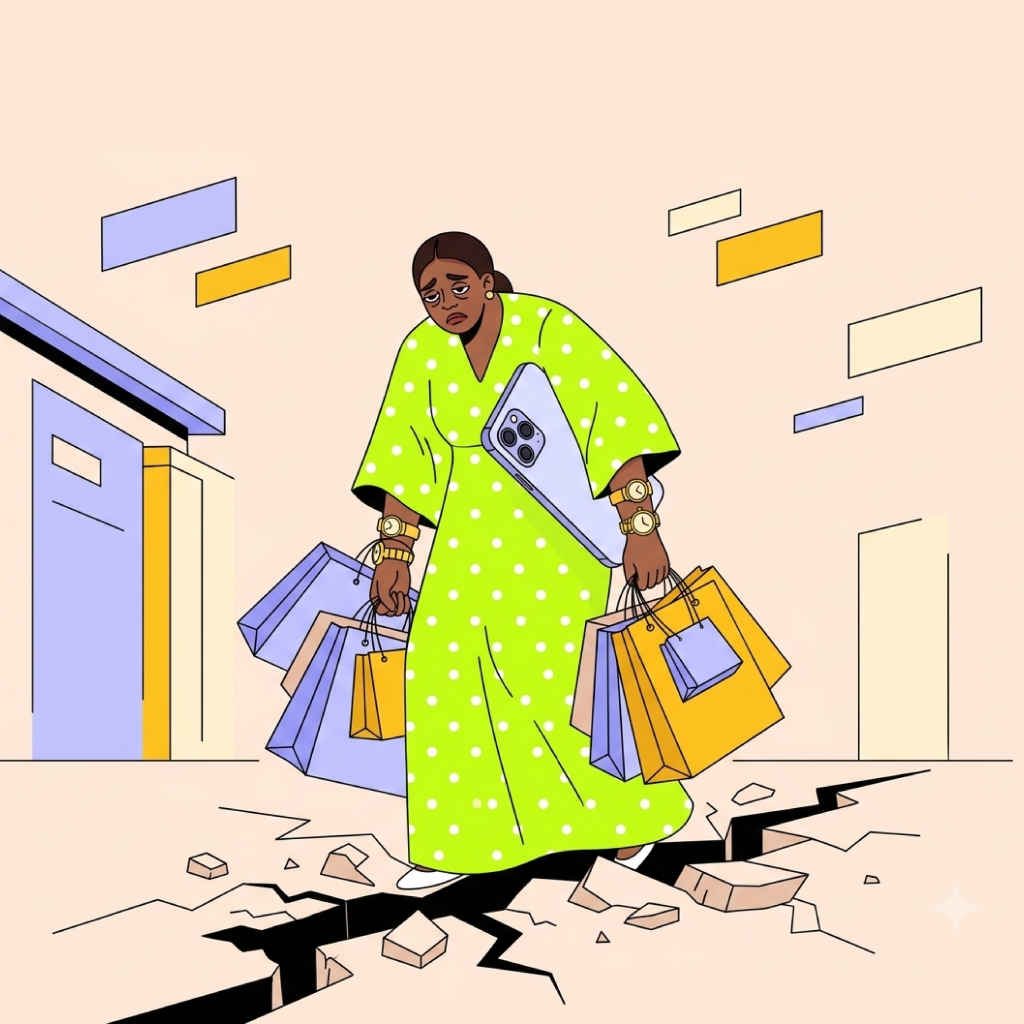

Why Nigerians Spend on Status Even When It Hurts
Status spending in Nigeria came up again a few months ago, in one of those WhatsApp group chats we keep having about money. The conversation centred on an aso ebi that cost more than some people’s monthly rent.
Everyone agreed it was ridiculous. The fabric would be expensive, and so would the tailoring. Makeup, shoes, transport, and all the extra costs that attach themselves to Nigerian weddings would be expensive too.
The complaints flew for days. I couldn’t keep up. Then, one by one, the same people who’d been complaining started explaining how they’d pay for it, if it were their turn to get married. Please, as how?
Nobody was excited about spending the money. No one thought it made financial sense. Yet almost everybody had a plan to spend money they clearly couldn’t afford.

The Aso Ebi Contradiction
Aso ebi is an everyday discussion on social media, especially among Nigerian women. So it wasn’t surprising when I came across a tweet from X user @Dammi_Esq. She complained about how much she’d spent on aso ebi she would never wear again after one event.
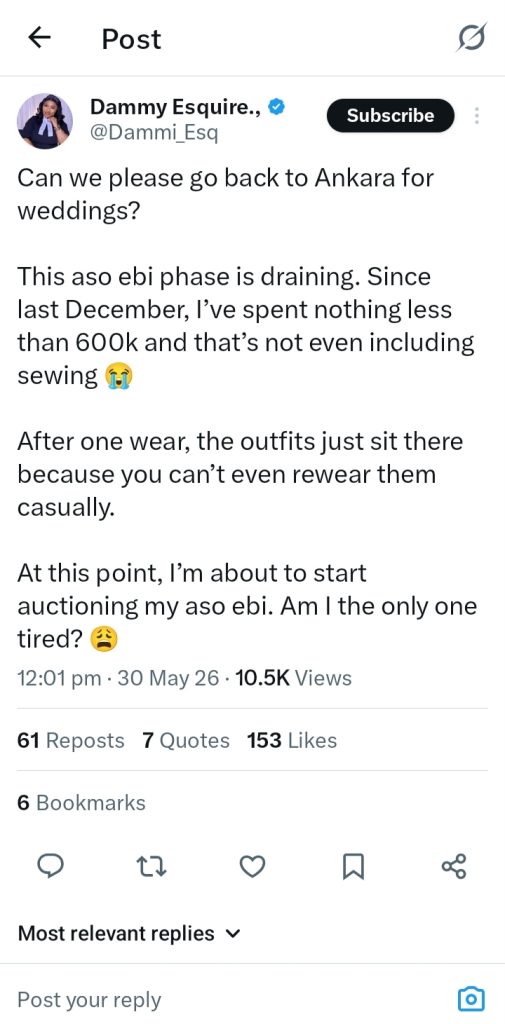
This contradiction, spending money you can’t easily afford, shows up everywhere in Nigerian life. It shows up when someone buys an iPhone they can barely afford, and in the pressure to look a certain way at an event. There it is again in the person stretching their budget for a car that draws fewer questions at a checkpoint.
We usually explain these choices with one word: vanity. But is it really just vanity?
Is It Really Just Vanity?
The popular story about Nigerians and status is that we care too much about appearances. We like to show off, to let everybody see that we’re not small. Underneath that is a habit of spending to impress people, prioritising the appearance of wealth over financial responsibility.
Sociologist Thorstein Veblen made a related point: wealth often seeks an audience.
“In order to gain and to hold the esteem of men, it is not sufficient merely to possess wealth or power. The wealth or power must be put in evidence,”
he wrote.
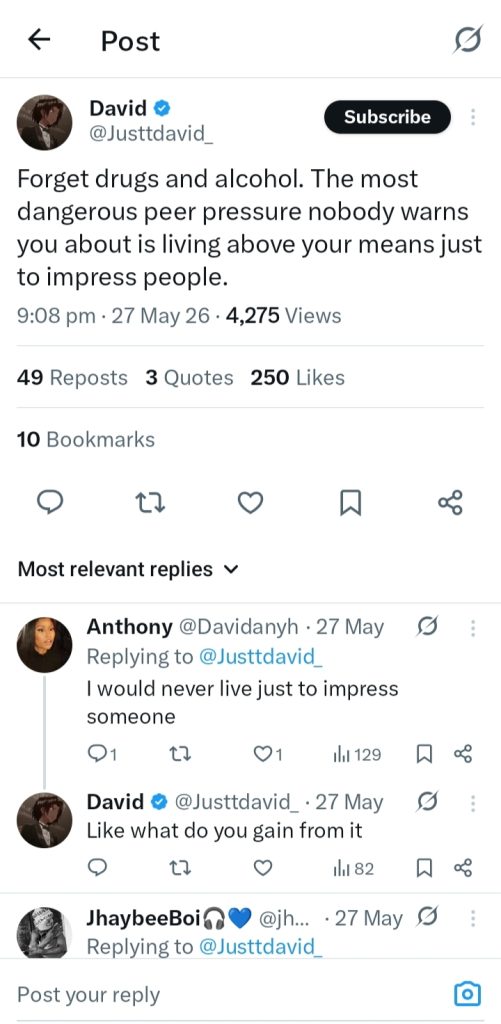
An X user I came across made a similar point, which only confirms how universal this problem is.
That explanation falls apart, though, the moment you watch how people actually move through this country.
Why Status Spending Makes Sense in Nigeria
In places where systems work the way they should, status is mostly decoration. It might shape how people see you, but it rarely determines whether you get access to basic services or basic respect.
Nigeria doesn’t always work that way. Most Nigerians have experienced the strange reality of being treated differently because of how they look or what they’re carrying. Sometimes it’s simply what people assume about them within seconds of meeting.
A bank customer dressed casually and one dressed in a full suit may be asking for the exact same thing. Officially, they should get the same treatment. Yet many Nigerians already know that appearances often decide who gets taken seriously, who gets served faster, and who gets the benefit of the doubt.
The same pattern shows up at the gate of an estate, during a traffic stop, at a reception desk, and in countless meetings and conversations. Nobody says status matters out loud, yet everyone behaves as though it does.
What Status Spending in Nigeria Is Really Protecting You From
When people talk about status spending, they usually focus on what the money bought: the aso ebi, the phone, the car, the apartment, the vacation. What they miss is what the spender believes those things will protect them from.
Take me, for example, paying over ₦100,000 for an aso ebi package. I’m not necessarily trying to impress strangers; I’m trying to stay connected to a social network that matters.
Nigerian weddings are rarely just weddings. They’re extended family gatherings, professional networking opportunities, community events. Who knows if the CEO of a company I’m interested in will be at my cousin’s wedding? Choosing not to participate can sometimes cost more than participating.
The same logic explains why conversations about iPhones never really end. On paper, the argument seems simple, since plenty of Android phones perform the same functions at a lower cost. Yet year after year, Nigerians keep stretching their budgets for iPhones.
It’s easy to dismiss this as poor financial decision-making, until you remember that phones are no longer judged only by what they do. They’re also judged by how much they cost.
A young professional walking into a client meeting knows this, and so does a freelancer trying to attract higher-paying work. It’s the same for anyone navigating dating apps, networking events, and industries where perception quietly shapes opportunity. The phone is doing more than making calls. Fair or unfair, it communicates something about the person holding it.
When Status Spending Goes Too Far
None of this means every status purchase is justified. Some spending is driven by pride, some by social pressure, and some by a genuine attempt to maintain an image that benefits nobody.
I experienced this firsthand in school, where girls would subtly, or not so subtly, check what phone you were using. Not an iPhone? Then you weren’t in their class bracket. They wouldn’t even hide it, saying things like, “Ohhh, it’s even Android you’re using.”
What they’re often wrong about is assuming everybody should be judged by the same yardstick. That’s part of why I keep wondering when the iPhone became a measure of wealth and class.
Nigerian writer and critic Pius Adesanmi once observed:
“In Nigeria, appearance is often mistaken for achievement.” wouldn’t you agree?

Who Gets to Opt Out of Status Spending
The people who can comfortably skip status spending usually have something else working in their favour. A respected surname, a powerful network, a prestigious job title, an international passport, or an accent that opens doors, these already function as social protection. It’s exactly what other people are trying to buy.
Sociologist Thorstein Veblen made a related point: wealth often seeks an audience.
“In order to gain and to hold the esteem of men, it is not sufficient merely to possess wealth or power. The wealth or power must be put in evidence,”
he wrote.
Looking around Nigeria, that observation still holds true. Success isn’t expected to stay quiet; it’s expected to announce itself, through the car, the clothes, the phone, the wedding, and increasingly, the Instagram post.
We keep asking why Nigerians spend so much on appearances. The more revealing question is why appearances continue to matter this much in the first place. That’s the real problem.
Does the country’s economic structure play a part in this do-or-die status spending? Perhaps, once there’s a real balance between the rich and the less privileged, some of this spending will stop hurting so much.